


In today’s hyper-connected digital ecosystem, your SAP landscape is not just software; it is the heartbeat of your enterprise. It holds your financial data, supply chain logistics, proprietary formulas, and employee records. But here is the alarming truth: Traditional security measures are failing. As cybercriminals evolve, relying on static firewalls and manual audits is akin to bringing a knife to a gunfight.
This brings us to the new frontier of defense: AI-Enhanced SAP Security.
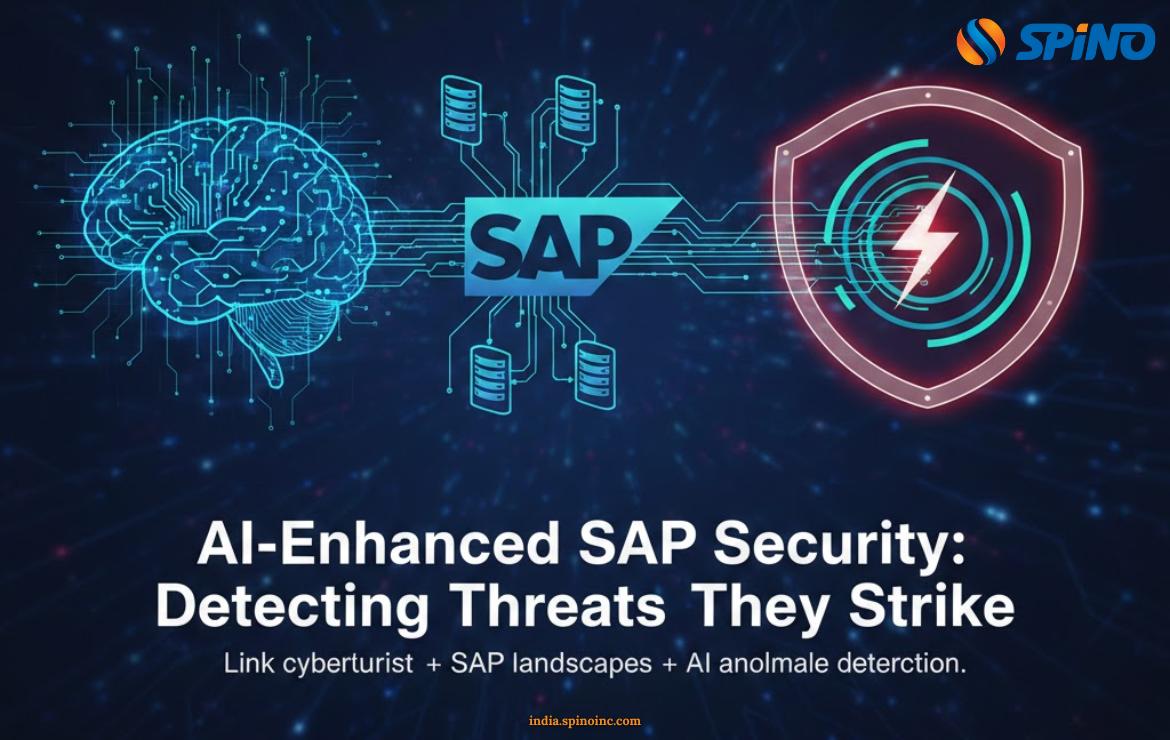
By linking advanced cybersecurity protocols with your SAP landscapes and leveraging AI anomaly detection, organizations can move from a reactive “clean-up” mode to a proactive “prevention” mode. In this comprehensive guide, we will explore how Artificial Intelligence is revolutionizing SAP security and how Spino Inc can help you stay ahead of the curve.
1. The Crumbling Wall: Why Traditional SAP Security is No Longer Enough
For decades, SAP security relied on the “Castle-and-Moat” approach. You built a strong perimeter (firewalls) and assumed everything inside the castle (your ERP) was safe.
However, the modern threat landscape has rendered this obsolete due to:
- The Dissolution of the Perimeter: With cloud migrations (S/4HANA), mobile access, and third-party API integrations, the “perimeter” no longer exists.
- Insider Threats: Statistics show that a significant portion of data breaches originate inside the organization—either from malicious employees or compromised user credentials. Traditional firewalls cannot see what a legitimate user is doing inside SAP.
- Rule-Based Limitations: Old security tools work on “rules.” (e.g., Alert if User X downloads 100 files). But what if a hacker downloads 99 files to stay under the radar? Rule-based systems miss this.
To combat this, enterprises must pivot toward AI-Enhanced SAP Security. This approach doesn’t just look for known bad signatures; it learns what “normal” looks like and flags everything else.
2. What is AI-Enhanced SAP Security?
AI-Enhanced SAP Security is the application of Machine Learning (ML) algorithms and Artificial Intelligence to monitor, analyze, and protect SAP environments in real-time. Unlike static tools, AI is dynamic.
The Core Mechanism: User Entity and Behavior Analytics (UEBA)
At the heart of AI-Enhanced SAP Security lies UEBA. Here is how it works:
- Baselining: The AI observes your SAP system for weeks. It learns that “John from Finance usually logs in at 9 AM from Mumbai and accesses T-Codes related to invoicing.”
- Continuous Monitoring: The system watches transactions 24/7.
- Anomaly Detection: If “John” suddenly logs in at 3 AM from an IP address in Russia and tries to download the entire vendor master data list, the AI flags this immediately.
This is the power of linking cybersecurity + SAP landscapes + AI anomaly detection. It creates a self-learning immune system for your ERP.
3. How AI Anomaly Detection Identifies Hidden Threats
AI anomaly detection is the secret sauce that makes modern SAP security effective. It goes beyond simple “if/then” logic. Here are the specific threats it detects that humans often miss:
A. The “Low and Slow” Attack
Hackers often use “low and slow” techniques to steal data over months to avoid triggering threshold alarms.
- Without AI: The security team sees small, insignificant data exports that look normal.
- With AI: The model detects a subtle statistical deviation in data export volume over a 30-day period and alerts the SOC team.
B. Privilege Escalation
A common attack vector involves a hacker compromising a low-level account and trying to gain ‘SAP_ALL’ or critical authorizations.
- Without AI: Audit logs are reviewed once a month, by which time the damage is done.
- With AI: The system detects a user executing unauthorized T-Codes or modifying tables (like USR02) in real-time and can trigger an automated lockout.
C. The “Impossible Travel” Scenario
If a user logs into SAP GUI from Bangalore and, 10 minutes later, logs in from London, this is physically impossible.
- AI-Enhanced SAP Security instantly recognizes this geographical anomaly and kills the session.
4. The Role of Spino Inc in Securing SAP Landscapes
At Spino Inc, we understand that SAP security is not a one-size-fits-all solution. As a leader in digital transformation and security, Spino Inc leverages cutting-edge AI to fortify your ERP.
We bridge the gap between IT infrastructure and SAP application layers. Our approach focuses on:
- Context-Aware Security: We don’t just report alerts; we provide context. Why is this behavior anomalous? What business risk does it pose?
- Zero Trust Integration: We help implement a Zero Trust architecture where no user—inside or outside—is trusted by default.
- Predictive Analysis: Using historical data, our solutions help predict potential vulnerabilities in your SAP transport landscape before they are moved to production.
Pro Tip: VisitSpino Incto learn how we customize threat detection models for specific industries, from manufacturing to fintech.
5. Key Benefits of Implementing AI in SAP Cybersecurity
Why should a CISO or CIO invest in AI-Enhanced SAP Security? The ROI is measured in risk mitigation and operational efficiency.
1. Reduced False Positives
Legacy SIEM tools are notorious for “alert fatigue.” They flag every failed login, burying the security team in noise. AI filters out the noise, understanding that a typo in a password isn’t a hack, but 50 failed attempts in one second is.
2. Real-Time Response
In cybersecurity, speed is everything. AI systems can trigger automated responses (SOAR) within milliseconds—blocking an IP or locking a user—stopping the threat before data is exfiltrated.
3. Compliance and Audit Readiness
For industries governed by GDPR, SOX, or HIPAA, AI-Enhanced SAP Security ensures that every transaction is monitored. It provides auditors with a clear trail of how anomalies were detected and handled.
6. Integrating AI Anomaly Detection into Your SOC
You cannot simply “install” AI; it must be integrated into your Security Operations Center (SOC).
- Step 1: Data Ingestion: Feed SAP logs (Security Audit Log, Read Access Logging, SM20) into your AI platform.
- Step 2: Training the Model: Allow the AI to run in “learning mode” to understand standard business processes.
- Step 3: Define Critical Assets: Tell the AI which data (e.g., HR salaries, Vendor Bank Details) requires the highest sensitivity.
- Step 4: Continuous Tuning: As your business grows, your AI models must be retrained to adapt to new business flows.
7. Future Trends: The Next Decade of SAP Security
As we look toward the future, AI-Enhanced SAP Security will evolve further:
- Self-Healing ERPs: Systems that not only detect a vulnerability (like an open port or weak parameter) but automatically patch it without human intervention.
- Biometric Integration: AI analyzing keystroke dynamics (how fast a user types) to verify identity continuously, not just at login.
- Quantum Resistance: Preparing SAP encryption methods for the post-quantum computing era.
Frequently Asked Questions (FAQs)
Q1: What is AI-Enhanced SAP Security?
AI-Enhanced SAP Security refers to the use of Artificial Intelligence and Machine Learning algorithms to monitor SAP systems. It automates threat detection by learning standard user behaviors and flagging deviations (anomalies) in real-time, offering superior protection compared to traditional rule-based systems.
Q2: How does AI anomaly detection work in SAP?
AI anomaly detection works by establishing a baseline of “normal” behavior for every user and system process. If a user performs an action that deviates from this baseline—such as accessing sensitive data at odd hours or from unusual locations—the AI flags it as a potential threat.
Q3: Can AI replace human security teams for SAP?
No, AI is designed to augment human teams, not replace them. It handles the heavy lifting of data analysis and pattern recognition, allowing human analysts to focus on investigating high-priority alerts and strategic decision-making.
Q4: Is Spino Inc equipped to handle S/4HANA security?
Yes, Spino Inc specializes in securing both legacy ECC environments and modern S/4HANA landscapes. Our solutions are tailored to address the specific cloud connectivity and database vulnerabilities associated with S/4HANA.
Q5: Why is traditional SIEM not enough for SAP security?
Traditional SIEMs often lack “business context.” They see technical logs but don’t understand SAP transaction logic. AI-Enhanced SAP Security understands the difference between a routine financial posting and a fraudulent transaction, reducing false positives and increasing accuracy.
Conclusion
The era of passive SAP security is over. The threats facing your ERP landscape are intelligent, adaptable, and relentless. Your defense must be the same.
AI-Enhanced SAP Security is not just a technological upgrade; it is a strategic necessity. By utilizing AI anomaly detection, organizations can illuminate the dark corners of their SAP systems, ensuring that threats are neutralized before they strike.
Don’t wait for a breach to reveal the gaps in your armor. Partner with Spino Inc to deploy a security framework that learns, adapts, and protects.
Ready to secure your SAP landscape? Contact Spino Inc today at https://india.spinoinc.com/ and schedule a comprehensive security assessment.