


Introduction: The Era of the Intelligent Enterprise
In the rapidly evolving landscape of enterprise technology, standing still is equivalent to moving backward. For decades, SAP has been the unrivaled “System of Record” for global businesses. However, in 2024, the demand has shifted. Organizations no longer just need a system that records data; they need a system that thinks. This is where SAP Generative AI enters the picture, marking the most significant shift in ERP technology since the cloud.
At Spino Inc, we are witnessing a revolution. SAP Generative AI is not merely a buzzword; it is a fundamental restructuring of how businesses interact with their data. By integrating the power of Large Language Models (LLMs) and the context-aware copilot SAP Joule, companies can now automate complex decision-making processes across Finance, Supply Chain, and Human Resources.
This comprehensive guide explores how SAP Generative AI is redefining enterprise workflows and how your organization can leverage these tools to build a future-proof Intelligent Enterprise.
1. What is SAP Generative AI and Why Does It Matter?
Before diving into specific modules, it is crucial to define what sets SAP Generative AI apart from traditional automation.
Traditional ERP automation follows rigid rules: If X happens, do Y. SAP Generative AI, on the other hand, understands context, nuance, and natural language. Powered by the SAP Business Technology Platform (BTP), it allows users to interact with their ERP system using conversational language.
The Role of SAP Joule
Central to this ecosystem is Joule, SAP’s generative AI copilot. Joule is embedded throughout the SAP cloud enterprise portfolio, meaning it doesn’t just live in a chat window; it understands the specific semantics of your business data.
- Contextual Awareness: It knows the difference between a “blocked invoice” in Finance and a “blocked vendor” in Procurement.
- Security First: Unlike public AI models, SAP Generative AI operates within the SAP Trust Layer, ensuring your proprietary data never leaks to public models.
Spino Inc Insight: Implementing SAP Generative AI is not just about installing a plugin. It requires a “Clean Core” strategy. Our team at Spino Inc specializes in preparing your data landscape to be AI-ready.
2. How SAP Generative AI Transforms Finance (FI/CO)
The Office of the CFO is under immense pressure to deliver real-time insights rather than just historical reporting. SAP Generative AI acts as a force multiplier for finance teams, shifting the focus from transactional processing to strategic analysis.
Revolutionizing Variance Analysis with AI
In a traditional setup, explaining why a budget variance occurred requires hours of digging through GL accounts and spreadsheets.
- The SAP Generative AI Workflow: A financial controller simply asks Joule, “Analyze the 15% variance in the marketing budget for Q3.”
- The Result: The AI scans thousands of line items, identifies that the variance is due to three specific unbudgeted vendor payments for a trade show, and drafts a variance report automatically.
Automating the Financial Close
The “Fast Close” is the holy grail of SAP FI/CO. SAP Generative AI accelerates this by:
- Narrative Generation: Automatically writing the commentary for Profit & Loss (P&L) statements.
- Intelligent Accruals: Predicting accruals based on purchase order history and un-invoiced receipts with higher accuracy than human estimation.
By partnering with Spino Inc, finance departments can configure these AI agents to match their specific compliance and reporting standards.
3. Optimizing Supply Chain (MM & SD) with SAP Generative AI
Supply chains are vulnerable to global disruptions. Agility is the only defense. SAP Generative AI empowers Supply Chain managers to predict issues before they become crises.
Conversational Procurement in SAP MM
Sourcing materials often involves navigating complex T-codes. SAP Generative AI simplifies this into a conversation.
- Scenario: A procurement manager needs to find a backup supplier for a critical component.
- AI-Driven Workflow: The user prompts: “Find alternative suppliers for ‘Electronic Chipset X’ in Southeast Asia with a sustainability rating above 80 and lead time under 2 weeks.”
- Outcome: The system queries SAP Ariba and S/4HANA, presenting a ranked list of vendors that match these criteria, saving days of manual research.
Proactive Logistics Management
SAP Generative AI can combine internal ERP data with external signals (weather, geopolitical news).
- If a hurricane is forecast to hit a key port, the AI copilot alerts the logistics manager: “Shipment #9002 is at risk of a 5-day delay due to weather. Should I re-route via Rail Route B or draft a delay notification to the customer?”
This level of proactive decision-making is what separates a standard SAP implementation from a Spino Inc optimized Intelligent Enterprise.
4. Human-Centric HR: SAP Generative AI in SuccessFactors
Human Capital Management (HCM) is perhaps the most natural fit for Generative AI because it revolves around language and communication. SAP Generative AI in SuccessFactors is changing the employee experience (EX).
Hyper-Personalized Job Descriptions
Recruiters spend countless hours writing job descriptions (JDs).
- The AI Solution: A hiring manager types, “Draft a JD for a Senior Solution Architect in Bangalore. Skills: SAP BTP, Python. Tone: Innovative and Inclusive.”
- SAP Generative AI generates a biased-checked, polished JD in seconds, mapped directly to the company’s competency framework.
The AI-Powered Career Coach
Employee retention is a major challenge.
- Employees can ask the AI: “I want to become a Team Lead next year. What skills am I missing?”
- The system analyzes their current profile, compares it to the Team Lead role requirements, and recommends specific courses from the SAP Learning Hub.
5. Technical Deep Dive: The Architecture Behind the Magic
To truly leverage SAP Generative AI, IT leaders must understand the underlying architecture. This is where Spino Inc’s technical expertise becomes invaluable.
The Role of SAP BTP and Vector Engines
The magic happens on the SAP Business Technology Platform (BTP).
- Vector Database: To make AI understand your specific business (e.g., your unique product codes), we use Vector Embeddings. This converts your structured SAP data into a format that LLMs can understand.
- Retrieval-Augmented Generation (RAG): This technique ensures the AI doesn’t “hallucinate.” When you ask a question, the AI retrieves real data from your S/4HANA system before generating an answer.
Data Privacy and the SAP Trust Layer
A common concern we hear at Spino Inc is: “Will my financial data be used to train ChatGPT?” The answer is No. SAP Generative AI utilizes the AI Trust Layer, which anonymizes and sanitizes data before it touches any model, ensuring strict enterprise-grade security and GDPR compliance.
6. Why Choose Spino Inc for Your SAP AI Journey?
Implementing SAP Generative AI requires more than just a software upgrade; it requires a strategic partner who understands both the business logic and the AI technology.
Spino Inc (https://india.spinoinc.com/) stands at the forefront of this transformation.
- Custom AI Strategies: We don’t believe in one-size-fits-all. We assess your specific pain points in Finance, HR, or Supply Chain and deploy targeted AI agents.
- Clean Core Methodology: We help you migrate to S/4HANA Cloud while keeping the core clean, ensuring that your AI extensions on BTP are scalable and upgrade-safe.
- Proven Expertise: Our consultants are certified in SAP BTP and AI technologies, ready to guide you from Proof of Concept (PoC) to Go-Live.
FAQ : SAP Generative AI & Enterprise Adoption
Here are answers to the most common questions CIOs and business leaders ask about implementing SAP Generative AI and Joule.
1. What is the difference between traditional SAP automation and SAP Generative AI?
Traditional SAP automation (like RPA) follows rigid, pre-defined rules (e.g., “If invoice > $5000, send for approval”). SAP Generative AI, powered by Joule, utilizes Large Language Models (LLMs) to understand natural language and context. It can generate content, summarize complex reports, and answer open-ended questions like “Why is our profit margin declining in Q3?”—something traditional automation cannot do.
2. Is my proprietary data safe? Will it be used to train public AI models?
This is the top concern for enterprises. The answer is: Yes, your data is safe. SAP utilizes the SAP AI Trust Layer on the Business Technology Platform (BTP). Your data is anonymized and strictly isolated. It is never used to train foundational public models (like generic ChatGPT) shared by other companies. Your financial and HR data remains within your tenant’s boundary.
3. Do I need to be on SAP S/4HANA to use SAP Joule?
Yes, to fully leverage SAP Joule and the latest SAP Generative AI capabilities, your organization should ideally be on SAP S/4HANA Cloud (Public or Private Edition). Legacy systems like SAP ECC do not support the cloud-native architecture required for these AI copilots. Spino Inc specializes in migrating legacy ERP systems to S/4HANA to make them AI-ready.
4. Can SAP Generative AI help with custom code generation?
Absolutely. For developers using SAP BTP, SAP Build Code with generative AI capabilities can automatically generate logic, unit tests, and data models based on natural language descriptions. This significantly reduces the development lifecycle for custom extensions.
5. Which SAP modules benefit most from Generative AI?
While the technology spans the entire suite, the highest impact is currently seen in:
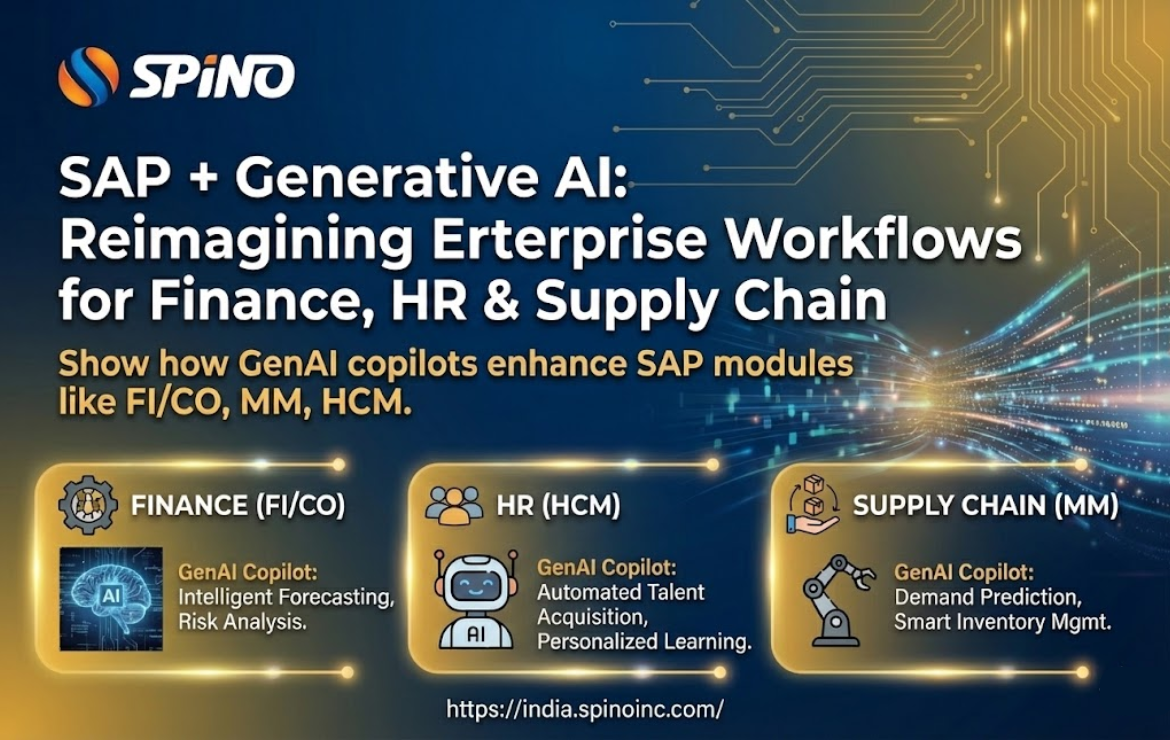
- SAP Finance (FI/CO): For variance analysis and automated narrative reporting.
- SAP SuccessFactors (HR): For recruiting, learning recommendations, and employee self-service.
- SAP Supply Chain (MM/SD): For predictive logistics and risk-aware procurement.
6. How does Spino Inc approach an SAP AI implementation?
At Spino Inc, we follow a “Clean Core” strategy. We don’t just bolt on AI; we ensure your underlying data is clean and governed. We start with an AI Readiness Assessment, identify high-value use cases (like automating AP inquiries), and implement them using SAP BTP to keep your core ERP stable.
7. Is SAP Generative AI expensive to implement?
The cost model is usually consumption-based via SAP BTP credits (AI Units). While there is a cost to usage, the ROI from time saved—such as reducing financial closing time by 20% or cutting recruitment screening time by 40%—often justifies the investment. Spino Inc can help you calculate a precise ROI forecast before you begin.
Conclusion: The Future is Generative
The integration of SAP Generative AI is not a distant dream; it is a present reality that is reshaping how industries operate. From automated financial closings to self-healing supply chains, the benefits are tangible and immense.
However, the window to gain a competitive advantage is closing. Organizations that adopt SAP Generative AI today will lead the market tomorrow. Those who hesitate risk being left behind in a manual world.
Are you ready to unlock the full potential of your SAP investment?
Partner with Spino Inc to chart your course toward the Intelligent Enterprise. Contact us today at: https://india.spinoinc.com/